

Can Dogs See UV Light? The Hidden World Your Dog May Be Seeing
Many pet owners know dogs have an incredible sense of smell, but did you know dogs see UV light, or
Order before 3pm and we ship the same day
Your cart information will not be stored on our servers
Take advantage of our multibuy discounts

Many pet owners know dogs have an incredible sense of smell, but did you know dogs see UV light, or at least may detect ultraviolet wavelengths that humans cannot normally see?
Most dog owners know that dogs have an incredible sense of smell. They can detect scents we would never notice, follow trails long after we have lost them, and gather an amazing amount of information from a simple sniff.
But their vision is fascinating too.
Recent interest in canine eyesight has highlighted something many dog owners do not realise: dogs may be able to see ultraviolet light, often called UV light.
This means your dog may notice parts of the world that are completely invisible to you. From biological scent marks to certain stains, bright white objects, movement in low light, and UV-reactive materials, your dog’s visual world may be far more unusual than we imagine.
One of the most interesting examples is urine. Urine can fluoresce under UV light, which means it can glow or stand out when exposed to ultraviolet light. This may help explain why dogs are so interested in lampposts, walls, patches of grass, corners of pavements and other places where other animals have left scent marks.
So, what does UV vision actually mean? Why might it benefit dogs? And what could your dog be seeing that you cannot?
Let’s take a closer look.
UV stands for ultraviolet.
Light is made up of different wavelengths. Humans can only see a small part of this range, which we call visible light. This visible light gives us the colours we recognise, such as red, orange, yellow, green, blue and violet.
Ultraviolet light sits just beyond the violet end of the visible spectrum. Humans cannot normally see it, but we know it exists because of its effects.
UV light can:
For humans, UV light is invisible. But some animals can detect it. Bees, birds, fish and some mammals are known or believed to use UV sensitivity in different ways.
Research suggests dogs may also allow some UV light into the eye, meaning they may see visual information that is hidden from us.
Studies looking at the eyes of different mammals have found that dogs have lenses that transmit a significant amount of UVA light.
In humans, the lens of the eye blocks most ultraviolet light before it reaches the retina. This protects the eye and helps us see sharp detail, but it also means UV light is invisible to us.
Dogs’ eyes appear to work differently. Their lenses seem to allow more UVA light through to the back of the eye. This suggests dogs may be able to detect some ultraviolet wavelengths.
This does not necessarily mean dogs see UV as a separate bright colour. We do not know exactly how a dog’s brain processes this information. It may appear as brightness, contrast, a different shade, or simply as something that stands out more clearly.
So it is better to say:
Dogs may be able to detect some ultraviolet light that humans cannot see.
Rather than:
Dogs see everything glowing.
The truth is likely more subtle, but still very exciting.
Dogs do not see the world in the same way humans do.
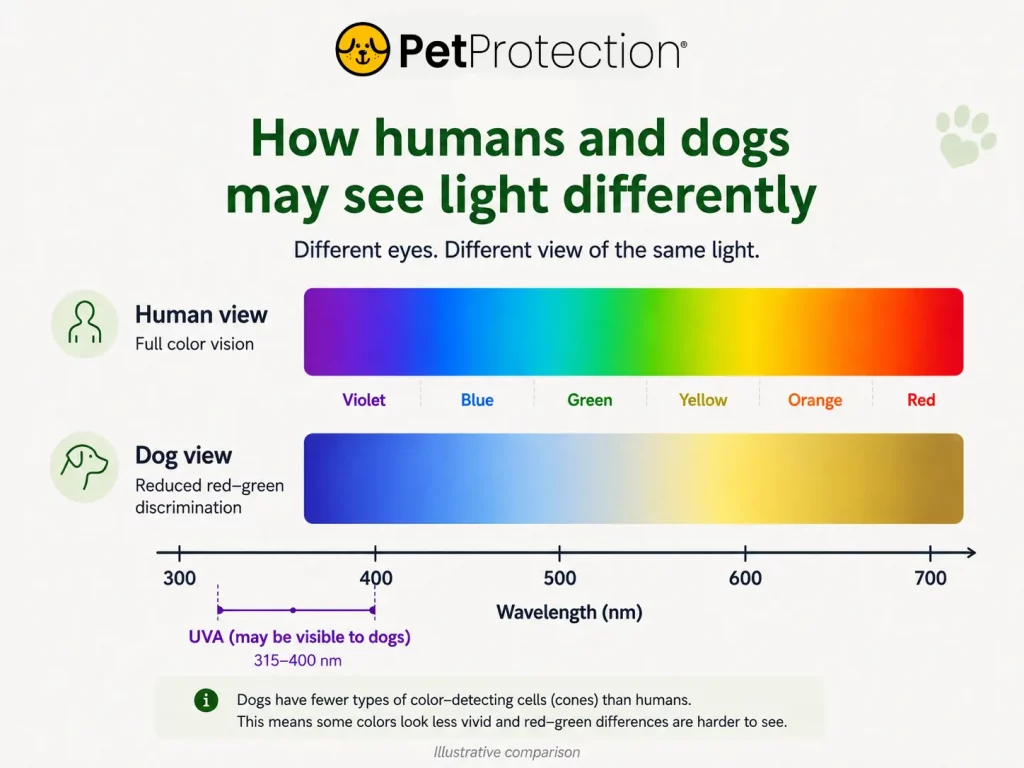
Humans usually have three types of colour receptors in the eye, allowing us to see a wide range of colours. Dogs have fewer colour receptors, so their colour vision is more limited. They are thought to see mainly in shades of blue and yellow, and may find it harder to tell the difference between colours such as red and green.
This is why a red ball on green grass may stand out clearly to you, but may not look as obvious to your dog.
However, dogs have other visual strengths.
Dogs are often better than humans at:
So while humans may see more colour detail, dogs may be better at noticing other types of information.
Their vision is not worse than ours. It is simply designed for a different way of experiencing the world.
Seeing UV means being able to detect light wavelengths that humans cannot normally see.
For your dog, this could mean certain things appear brighter, more contrasted or more noticeable than they do to you.
Some substances reflect UV light. Others absorb UV light and then emit visible light, which is known as fluorescence. This is why certain materials glow under a UV torch or blacklight.
You may have seen this effect with:
To us, many of these things look ordinary in normal daylight. But to an animal with UV sensitivity, they may appear different.
This does not mean your dog is walking around in a glowing neon world. It means your dog may have access to extra visual clues that are invisible to you.
This is one of the most fascinating parts of UV vision.

Urine can fluoresce under ultraviolet light. This is why UV torches are often used to find hidden pet urine stains on carpets, rugs, floors, bedding and furniture.
When UV light hits certain compounds in urine, the area may appear to glow. Depending on the surface and the age of the stain, it may look yellowish, greenish or pale.
For humans, dried urine can be difficult to see. We may only notice it if there is a visible stain or strong smell.
But dogs may have an advantage.
If dogs can detect some UV wavelengths, then urine marks may stand out to them more than they do to us. Combined with their powerful sense of smell, this could make scent marks even easier for dogs to find and investigate.
This may help explain why dogs spend so much time sniffing:
To us, these places may look completely normal.
To your dog, they may be full of scent information and visual clues.
One of the most interesting possible benefits of UV sensitivity is that dogs may notice certain pale or white objects against pale backgrounds better than humans can. To us, a white rabbit sitting on snow, a pale toy on a light carpet, or a white object against a bright background may blend in and become difficult to see. But if dogs can detect some ultraviolet wavelengths, those objects may reflect light differently and create extra contrast that our eyes cannot pick up.
This could have been especially useful for dogs’ wild ancestors. In nature, many animals rely on camouflage to stay hidden, particularly in snow, grass, sand or woodland. If a white animal on snow reflects ultraviolet light differently from the snow around it, it may stand out more clearly to a UV-sensitive animal. This does not mean dogs see perfectly or that every white object glows, but it may give them additional visual clues that help them detect movement, shape and contrast.
For dogs, this could offer real benefits. It may help them spot small animals, follow movement in low light, notice objects that humans overlook, and understand their surroundings more quickly. Combined with their powerful sense of smell and hearing, this means dogs are not just seeing the same world we see — they may be picking up hidden details that are completely invisible to us.
Below is an illustration as to how a white rabbit on snow might appear to dogs compared to humans.

Dogs learn a huge amount from urine.
A urine mark can tell a dog that another animal has passed through the area. It may also provide information about sex, hormones, health, stress, confidence and how recently the animal was there.
This is why people sometimes call urine marking “pee mail”.
To humans, that may sound funny, but it is actually a useful way of understanding dog behaviour. When your dog stops to sniff a post or patch of grass, they may be reading messages left by other dogs.
If those scent marks also stand out visually because of UV fluorescence, dogs may not be relying on smell alone. UV sensitivity could help guide them towards areas worth investigating.
Your dog may be smelling the message and possibly seeing where the message has been left.
This makes a simple walk far more interesting from your dog’s point of view.
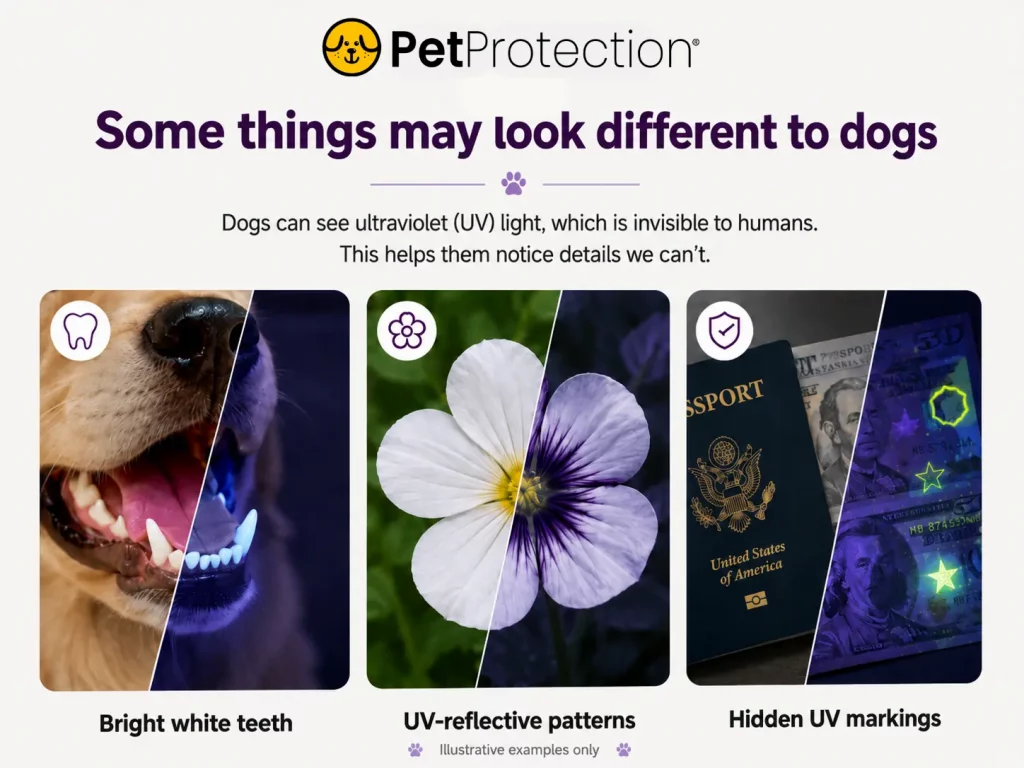
Urine is not the only biological substance that may react under UV light.
Other substances, including saliva and some bodily fluids, can also fluoresce or appear differently under UV. This may be useful in the natural world, where animals leave behind traces as they move through their environment.
For dogs and their wild ancestors, this could have helped with:
Our pet dogs may no longer need these skills for survival, but they still have many of the same instincts.
This may be one reason dogs seem so fascinated by tiny details outdoors. They are not simply sniffing randomly. They are gathering information from a world we cannot fully see or smell.
One interesting idea is that teeth may look brighter to dogs than they do to humans.
Teeth can fluoresce under UV light. Certain compounds in teeth, as well as residues from toothpaste or other substances, may make teeth appear brighter under ultraviolet light.
This does not mean your dog sees your smile exactly like a UV photograph. But it is possible that teeth, white objects and some pale materials stand out differently to dogs because of the way they reflect or fluoresce under UV.
This is another reminder that your dog’s view of everyday life may be very different from your own.
Something as ordinary as a smile, a white sock, a pale toy or a white patch on another dog’s coat may look more noticeable to your dog than you realise.
Many everyday objects can contain UV-reactive features.
These may include:
Humans usually need a UV light or blacklight to see these effects clearly. But if dogs can detect some UV, certain objects may appear different to them without us noticing anything unusual.
This does not mean your dog understands what a passport security mark or bank note feature is. But they may see patterns, brightness or contrast that you cannot.
It is also a useful reminder to keep valuables out of reach. Dogs do not care whether something is important, expensive or official. If it smells interesting or feels good to chew, it may still be at risk.
Dogs are already better adapted than humans for seeing in dim light.
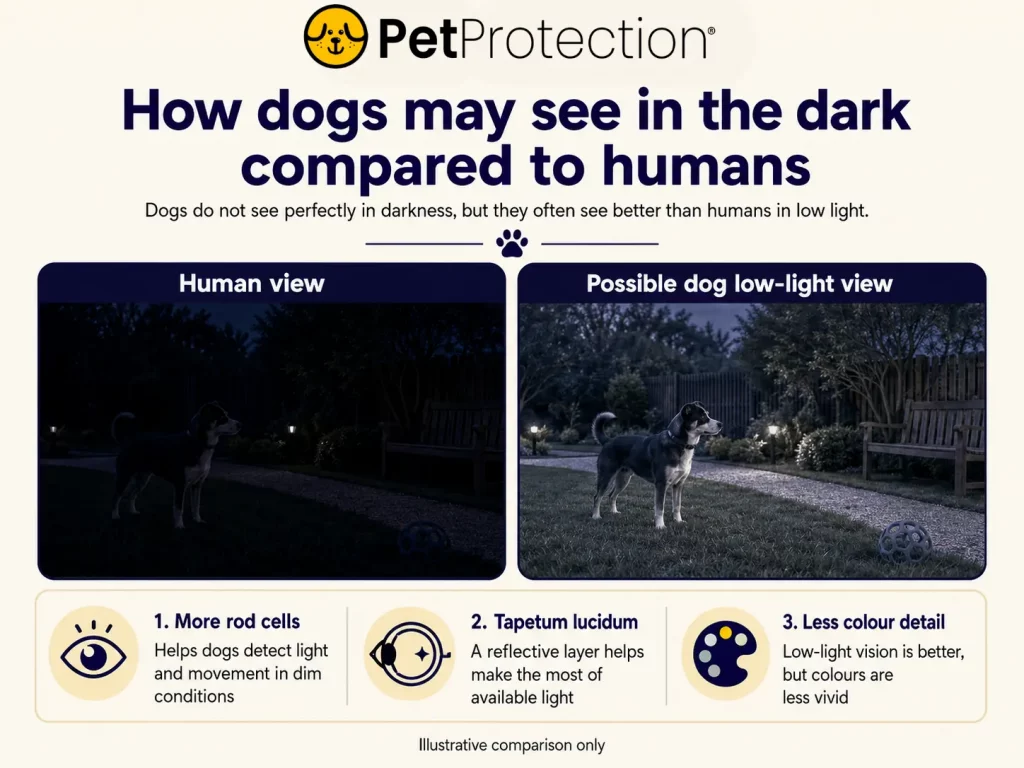
Their eyes are designed to help them detect movement and shapes when light levels are low. This is partly because dogs have more rod cells, which are useful for low-light vision, and a reflective layer behind the retina called the tapetum lucidum. This helps bounce light back through the eye, improving sensitivity in darker conditions.
UV sensitivity may add another layer of visual information in certain situations, especially where surfaces reflect short wavelengths of light.
This does not mean dogs can see perfectly in the dark. They still need some light. But their eyes are generally better suited than ours to low-light movement and contrast.
This may help explain why dogs sometimes notice movement in the garden, hallway or street before we do.
Some articles suggest dogs may see the night sky differently because of their UV sensitivity and low-light vision.
This is possible in a broad sense, because dogs may detect certain contrasts and movements differently from humans. However, we should be careful not to overstate this.
We cannot say for certain that dogs see more stars or planets than we do. Their vision is not as sharp as human vision for fine detail, and the way they process UV information is not fully understood.
What we can say is that dogs experience low-light environments differently from humans. They may notice movement, contrast and light changes that we miss.
So when your dog stares into the dark or suddenly reacts to something outside, they may genuinely be picking up information that is not obvious to you.
There are several possible benefits to UV sensitivity.
Urine markings are an important part of canine communication. If these markings are easier to see under UV, dogs may be able to find them more easily.
This could help dogs identify who has been in an area, whether another dog is nearby, and how recently a scent was left.
Wild canines and their ancestors would have benefited from detecting trails left by other animals.
Urine, saliva, fur, skin oils and other biological traces may provide useful information. UV sensitivity could make some of these traces more noticeable.
Even domestic dogs still have strong tracking instincts, which is why walks, sniffing games and scent work can be so mentally rewarding.
Dogs are good at noticing movement. If UV sensitivity adds extra contrast in some environments, it may help dogs detect things that humans miss.
This could be particularly useful in low light, shaded areas or natural environments.
Dogs are constantly building a picture of the world around them.
They use smell, sound, sight, body language, memory and instinct. UV sensitivity may be one more tool that helps them understand where they are and what has happened there.
A patch of grass may not just be a patch of grass. It may contain scent marks, animal trails, old urine, saliva, disturbed vegetation and other clues.
Your dog is not being difficult when they stop to investigate. They may be reading the environment in a way we cannot.
In normal everyday life, UV sensitivity is not usually something owners need to worry about.
However, dogs’ eyes, like ours, should still be protected from excessive sunlight and harsh environmental conditions where possible.
You should take sensible precautions such as:
Some dogs may be more sensitive to bright light, especially dogs with eye conditions or certain facial structures. If you are concerned about your dog’s eyes, always ask your vet.
Yes, a UV torch can be useful if you are trying to find hidden urine stains indoors.
This can help if:
For best results, use the UV torch in a dark room and scan slowly.
However, remember that not everything that glows is urine. Some cleaning products, dust, fibres, food marks and old stains can also fluoresce.
If you find a likely urine stain, use a pet-safe enzymatic cleaner. Ordinary cleaning products may remove the visible stain but leave behind scent residues that dogs can still detect. If the scent remains, a dog may return to the same spot.
UV torches can help locate urine stains, but they cannot tell you why your dog is urinating.
Speak to a vet if your dog:
Changes in urination can be linked to urinary tract infections, bladder problems, kidney disease, diabetes, anxiety, pain or age-related changes.
It is always better to check early.
The idea that dogs may see ultraviolet light is a wonderful reminder that dogs experience the world in ways we cannot fully understand.
They smell things we cannot smell.
They hear things we cannot hear.
They notice movement we miss.
And they may see visual clues that are invisible to us.
This can help us become more patient with our dogs. When your dog stops to sniff the same lamppost, stares at a patch of grass, or investigates a corner of the room, they may be responding to something real — even if you cannot see it.
To us, the world may look ordinary.
To a dog, it may be full of hidden trails, marks, patterns and messages.
Research published in Proceedings of the Royal Society B suggests that dogs’ eye lenses transmit significant amounts of UVA light, meaning dogs may be sensitive to ultraviolet wavelengths that humans cannot normally see, click here to read.
A question we have been asked is whether some dog breeds may see ultraviolet light better than others. For example, could a working breed, hunting breed, sighthound or northern breed have stronger UV vision than a small companion breed?
At the moment, this is still an area where more research is needed. The main scientific evidence suggests that dogs, as a species, may be able to detect some UVA light because their eye lenses allow certain ultraviolet wavelengths to pass through to the retina. However, this does not yet tell us whether different breeds vary in how much UV light they can detect, or whether some breeds use this ability more than others.
It is possible that breed differences could exist, especially because dogs vary so much in eye shape, head shape, coat type, lifestyle and working history. A breed developed for hunting, tracking or working in low-light conditions might rely heavily on movement, contrast and environmental clues. However, we should be careful not to overstate this. At present, there does not appear to be clear evidence proving that one breed sees UV light better than another.
What we can say is that canine vision is very different from human vision. Dogs generally see fewer colours than humans, are better at detecting movement, often perform well in low light, and may have access to some ultraviolet information that we cannot see. Whether a Labrador, Spaniel, Husky, Terrier, Poodle or Chihuahua experiences UV light in exactly the same way is still something science has yet to fully answer.
For now, the safest conclusion is that dogs may have some UV sensitivity, but breed-by-breed differences remain largely unknown. It is a fascinating topic, and future research may help us understand whether different types of dogs experience this hidden part of the visual world in slightly different ways.
Dogs are extraordinary animals, and the more we learn about them, the more fascinating they become.
Their possible ability to see ultraviolet light may help them notice scent marks, urine trails, biological residues, movement, contrast and UV-reactive objects that humans cannot see.
This does not mean dogs see everything glowing brightly. The reality is likely more subtle. But it does mean their world may contain layers of visual information that are completely hidden from us.
So next time your dog pauses on a walk, takes extra time at a lamppost, or becomes fascinated by a patch of grass, try to see it from their point of view.
They may not be wasting time.
They may be reading a hidden world.
This article references research published by the Royal Society, which suggests that dogs may be sensitive to some ultraviolet wavelengths due to the way their eye lenses transmit UVA light.
Keeping your pet healthy starts with understanding the world from their point of view — from what they see and smell, to how they move, digest, relax and age. At PetProtection, we offer a range of carefully selected supplements for dogs and cats, designed to support everyday well-being, including joint care, digestion, calming, skin and coat health, dental care and more. To explore our full range and find the right support for your pet, visit PetProtection today.
Many pet owners know dogs have an incredible sense of smell, but did you know dogs see UV light, or

A practical UK guide to common plants, flowers, trees, berries and fungi that can be dangerous to dogs and cats,

A practical UK guide to common insect bites and stings on dogs and cats, including fleas, ticks, bees, wasps, horseflies,

Natural supplements for dogs and cats can help support digestion, joint mobility, skin health, immunity, and emotional balance. This guide
Wondering what supplements are best for your dog at different ages? This guide explains which supplements can help support healthy


Signs your dog needs supplements aren’t always obvious, but understanding them can help support long-term health and well-being. Most pet

Supporting your dog’s digestive health is essential for overall wellbeing. Probiotics and prebiotics help maintain a balanced gut microbiome, improving
Dogs with sensitive stomachs need gentle, consistent digestive support. This guide explores the best supplements to help improve gut balance,

What does “fortified” really mean in pet supplements? This article explains how fortification works, why it matters for dogs and

Goat’s milk is a gentler, more digestible alternative to cow’s milk for pets. Naturally rich in bioavailable nutrients and lower

Discover why seaweed is becoming a popular ingredient in pet dental care. Learn how seaweed dental powder helps reduce plaque

Learn how fortified goat’s milk powder provides gentle digestion, immune support, and complete nutrition for dogs and cats.